
Successes:

There were many successes in my classroom this year. If you were a teenager in my class, you got to:
Read A LOT. For Pleasure!
- By the end of the year, we were writing book reviews about the novels you were reading, and they were analytical in nature. Higher level thinking skills abounded! One year end thank you note from a student said, "Thank you Ms. Quinn for the awesome year! Also thank you for getting me interested in some awesome books."
- We read a couple of great novels together as a class, especially The House of Scorpion by Nancy Farmer. You loved this book, and begged me to keep reading. Your teacher had this novel up on the SMART Board, so you could read along if you wanted to, but you could just sit and listen if that was better for you. There were also some hard copies floating around the room that you could use, too, if that was better. Your teacher gave you lots of choice in ways to experience this book - listening, reading along on the board or with a book. We experimented with back channel chatting during this read. Sometimes, it was awesome and people asked great questions and commented on the book as we read. Sometimes, it just disintegrated into a big giant trollfest. Your teacher needs to think about this some more and figure out how to teach the digital citizenship needed to make this work. Because it has SO much potential for greatness!
Wrote a lot, Too.
- We started the year off writing poetry. This was really fun. We played around with Writer's Circles, and sat in a circle and had a chance to share our work. We learned about "plussing" and constructive criticism. Your teacher learned about the value of student-driven on-the-spot feedback. Giving that verbal feedback to each other impacted the way we wrote.
- We started blogs on Kidblog. We used them to respond to reading. Your teacher thought they did the job, but they could be so much greater if you got to choose the topic.
Did Some Cool Social Studies Projects
- We did a Middle Ages reenactment, complete with M&M feudalism!
- We had a Renaissance Faire where we had to connect advancements in a field with current advancements in a corresponding field here in Calgary.
- We created our own 4 Pics, 1 Word game about the Aztecs. We had fun playing the game as a class.
- We created a dialogue between a Spanish and an Aztec person, in whatever format we wanted. Many of us chose GoAnimate.
- We did a huge simulation project of isolation and the opening of the borders in Edo and Meiji Japan. We each had a role to play, we each had a goningumi (which is a group of family leaders who were rewarded and punished as a group during the Edo period), we built a model village, and earned money (rice) in a false economy. We had to figure out lots of really essential questions like, "Why would a society choose to close itself off from the rest of the world?" and "How would we rapidly adapt when borders were reopened?"
- And we started on our favourite project of the year, the cross-curricular final project, where we had to choose or invent a significant environmental and cultural shift that would really impact our worldview. Unfortunately, a real environmental shift prevented us from finishing this project: the insane Calgary flood of 2013! School was cancelled for four days, something unheard of here in Calgary (we go to school in blizzards when it's -40 below!), and returned to school only for our last day of classes, so we never got to finish the project. Our teacher noted incredibly high levels of engagement while we were working on this prior to the flood, because of the incredible amount of choice we had to choose a topic that interested us, as well as the fact that it was relevant and real.
We Experimented with 20% Time
- We used Google's 20% Time policy as our inspiration, and we got to explore anything under the sun that intrigued us. We asked ourselves, What have you always wanted to learn? What have you always wanted to make? And it was fun. Some of us struggled in the beginning to find our passions, but we all settled on something that we were happy to spend time getting lost in. Here are some of the things we did: a girl taught herself to play piano and composed a song, a boy learned Python and coded a computer program, a boy used Sploder to design a computer game, a girl wrote a blog about basketball, a girl created a travel guide to Paris and London, a boy taught himself landscape drawing and produced three drawings, a girl wrote her own personal manifesto, and a boy tried (and failed, but that was part of the learning!) to build a generator. We had a mini Maker Faire at the end of our project time to show off our great work!
Failures:
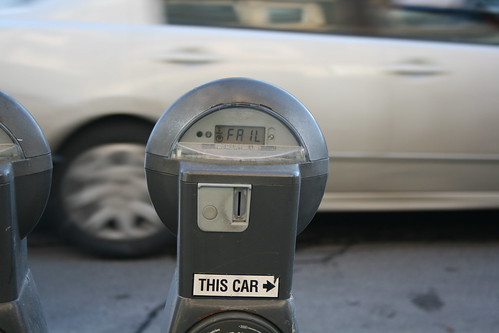 |
There were failures. Oh yes. These failures are spinning around in my brain right now and I am trying to solidify a plan for how to make it better next year. Here's what I consider failures in my teaching this year:
- Despite it all, I needed to constantly remind kids to get on task. What this tells me is that although I carefully planned the learning my students would do to be engaging (and when they were on task, they were generally pretty engaged), they weren't in the driver's seat. I am trying to figure out how, practically, to organize my students' learning so that THEY are completely in charge of it.
- Direct teaching a group of 30 kids sucks. I recognize direct teaching is necessary sometimes, but I am trying to figure out how to organize my students' time so that I can teach small groups. I may also investigate the flipped classroom technique to see if that would work for some concepts.
- I had one class that was really, really chatty. Like, I could not get through an instruction without being interrupted. It was rude and disrespectful and I couldn't figure out how to turn it around, so it kept getting worse and worse. I need to think about how to organize my students' learning so that I don't have to stand up in front of a class of 30 kids to explain what they should be doing that class. I need to figure out, again, how to put my students in the driver's seats and have them give themselves the instructions. Self-instigated, personalized, learning will be the key.
- Although I built lots of choice into every learning activity, my students were generally working on the same task (albeit in different ways) at the same time. I want to experiment with different ways of organizing class time. I want to see what it might be like to have some students working on writing, some working on social studies projects, and some engaged in a minilesson with me about reading. I just have to figure out how to manage this.
- I spent hours and nights and WEEKENDS of my time marking. I need to stop doing this. It's punishment for not assessing as the students are doing the learning. I need to figure out better ways to assess formatively and summatively IN the classroom, WITH the kids. I am especially confused as to how to do this with writing. I need to have a really good think about this.
- My school was built four years ago and was designed for inquiry-based, personalized learning. My classroom is a polygon shape, with no clear "front of the room." There's a sliding glass wall that separates my classroom from the one next door. There's whiteboards on two walls. There's a SMART board off centre on one of the white boards. I experimented with physical design for maximum creativity last year (the first couple of months, the student desks were pushed to the edges of the room, with the chairs in the middle), but I want to amp this up tenfold next year. I am toying with the idea of tasking my students to research and design the optimal learning space. I want to bring in all kinds of seating to give my students options for how they want to be in the space. I want to keep pushing the boundaries of what a classroom should look like.

